
Case studies
Modernization grounded in real application work.
These projects reflect the experience and capabilities of our team.
Prior Team Experience • Global manufacturer
Modernizing a mature Rails application, module by module.
- Global manufacturer
- Business-critical application
- Module-by-module modernization
The situation
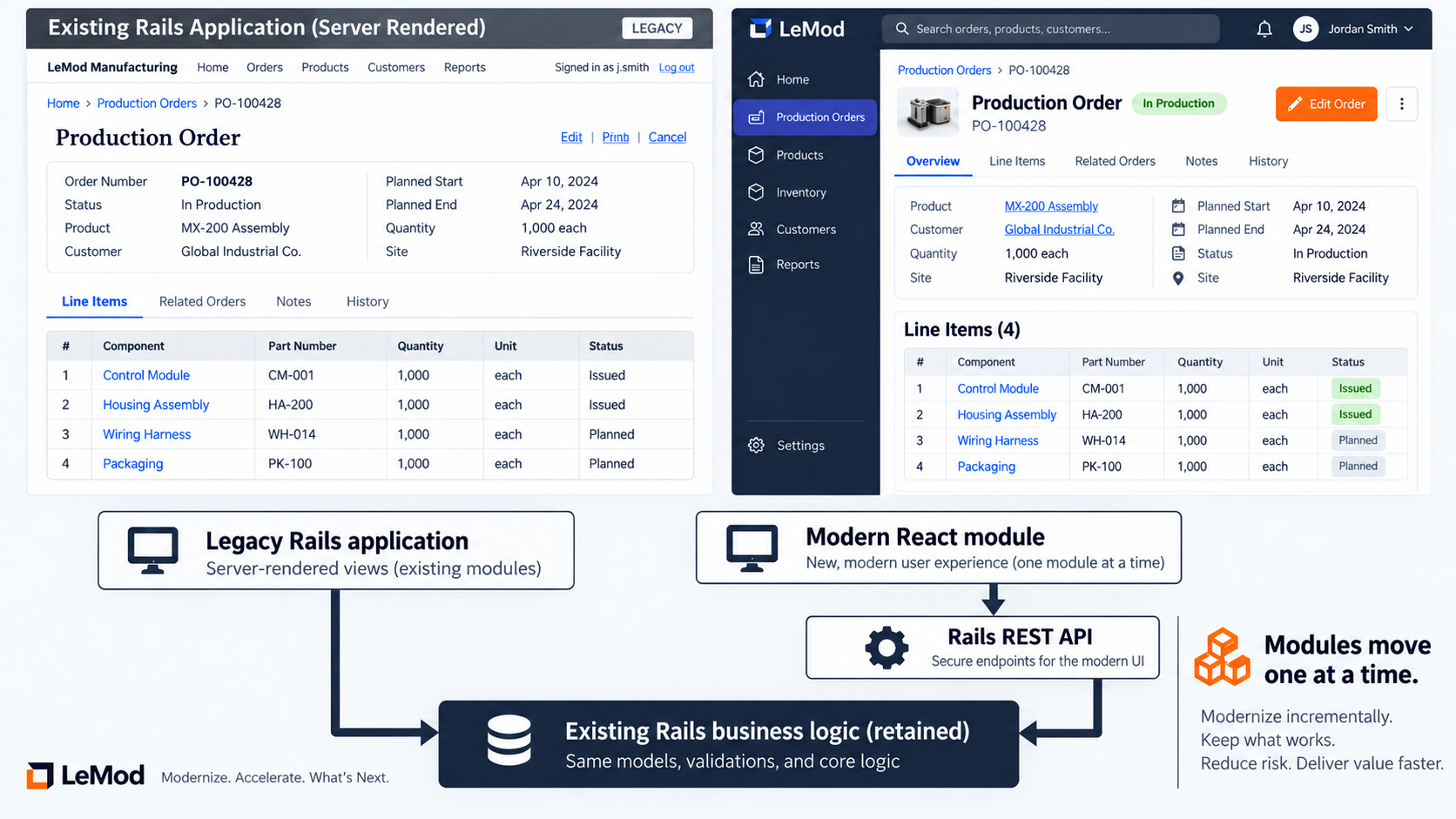
Members of the LeMod team worked with a global manufacturing company on a mature Rails application with server-rendered views. The application held business logic the company relied on.
The challenge
The interface needed to change, but the business logic was proven and valuable. Replacing it all at once would have put that logic at risk.
The approach
The existing Rails business logic was kept. Rails REST APIs exposed what the application already did. React replaced the server-rendered screens one module at a time.
What this shows
The interface can be modernized without a wholesale replacement of the business logic behind it.
Preserve what already works
Avoid the big-bang rewrite
Modernize module by module
Prior Team Experience • Travel operations
From an AS/400 back-office system to a modern application platform.
- Business-critical operations
- Incremental transformation
The starting point
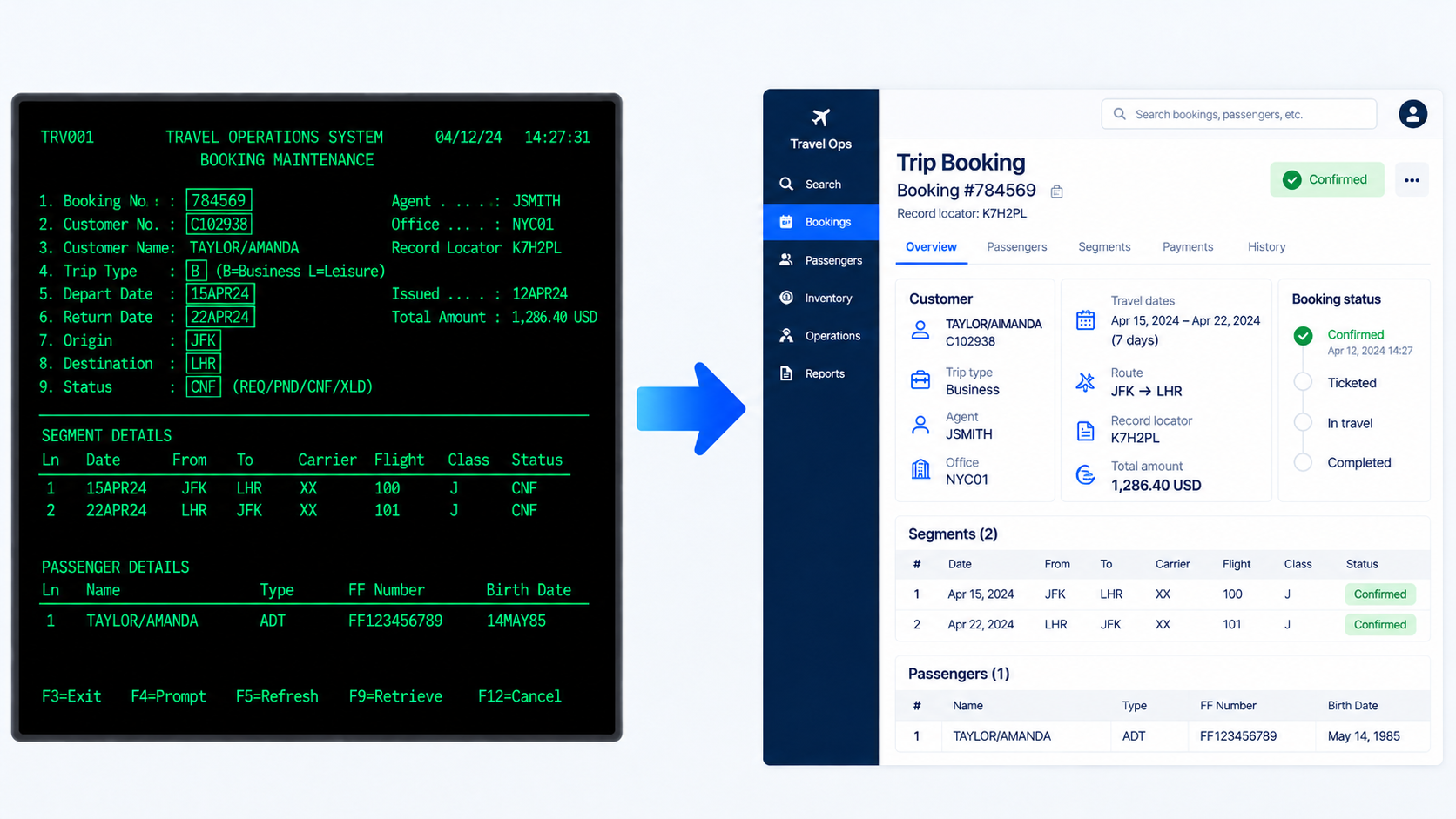
A travel company ran its back-office operations on an IBM AS/400 application. The modernization team worked side-by-side with in-house experts to reconstruct the business logic from screens, fields and workflows—without access to source code.
Build the first web-based replacement
Core back-office operations moved from the AS/400 environment to a new web-based application, which continued to evolve for years.
The current transformation
As parts of that foundation reached end-of-life, the application is being rearchitected around a modern React frontend and REST API layer—incrementally, AI-assisted and human-controlled—while hardening the engineering foundation and redesigning the user experience.
Modernization can begin without source code
Institutional knowledge is an asset
Make change safer
Your application may not need a rewrite.
Find out where modernization can create the most value with the least unnecessary risk.